
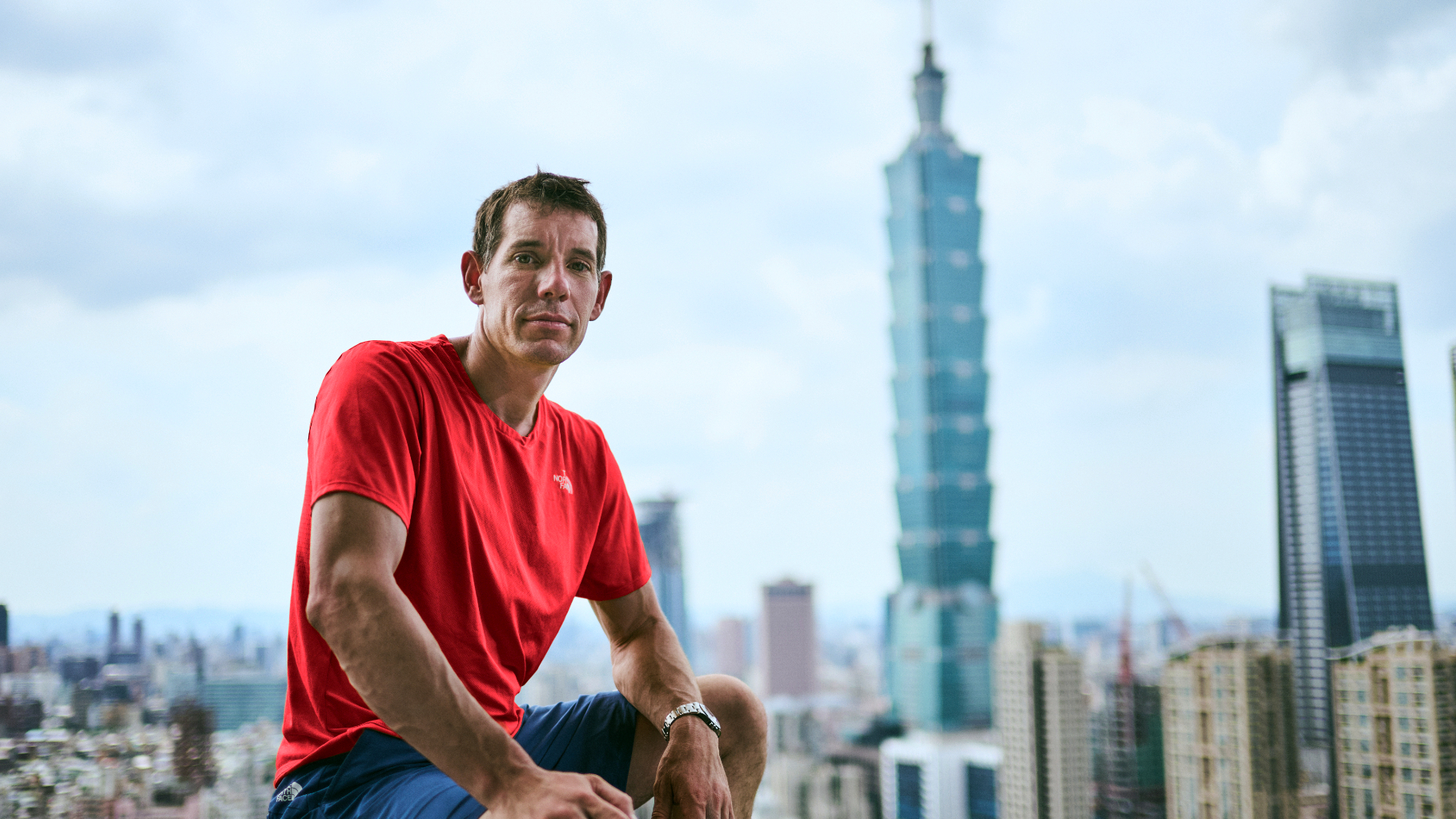
Taipei, January 25, 2026, as the winter wind shrieked through the gaps between skyscrapers, creating a near-deafening howl, a tiny figure moving with the deliberate precision of a gecko clung to the iconic green glass curtain wall of Taipei 101. At that moment, hundreds of millions of people around the world held their breath. This was Alex Honnold, the man known as having “the heart of a mountain goat,” once again standing on the precipice between life and death.
If you have seen the Oscar-winning documentary Free Solo, you will surely remember his silhouette against the sheer 900-meter granite face of El Capitan in Yosemite National Park. This time, in Taipei, he faced the pinnacle of artificial architecture—the 508-meter tall Taipei 101. With no ropes, no safety nets, and no chance to turn back, he carried only a bag of chalk at his waist to dry his sweat and wore a pair of specialized climbing shoes. Amidst the collective gasps of a global audience glued to their Netflix screens, he began a 91-minute dance with the Reaper.
Completed in October 2003, Taipei 101 is the world’s 11th tallest building. Its structure mimics bamboo segments, with each section tilting outward at an angle of 10 to 15 degrees. In Chinese culture, this symbolizes the auspicious meaning of rising prosperity, but for a climber, it means that every eight floors, he must battle a gravitational force pushing his body outward. This continuous eccentric muscle contraction drains physical energy at an exponential rate. As he ascended, the wind speed at 500 meters became completely uncontrollable; Force 6 gusts caused the heavy glass curtain wall to visibly vibrate in the high-definition lens. The most terrifying moment occurred at 300 meters: in order to adjust a slightly shifted piece of equipment on his back, Honnold briefly released both hands while completely unsupported. For that single second, the global livestream chat was flooded with the words “It’s over,” but almost instantly, his hands—measured to have a grip strength of 95kg, twice that of an average adult male—snapped back onto the metal seams like magnets.
In fact, Honnold’s resume is itself a textbook on extreme focus. Born in Sacramento, California, in 1985, the climber was not a naturally gifted “prodigy.” He began practicing in indoor climbing gyms at age 5 and climbed multiple times a week by age 10, yet he humbly described his teenage self as “unremarkable,” with strength and technique far inferior to his talented peers. At 18, he enrolled in the Civil Engineering department at the University of California, Berkeley, but following the death of his maternal grandfather, his parents’ divorce, and his father’s sudden death shortly after, he chose to drop out of this prestigious university. This upheaval made him realize that “life is not worth living if not for happiness,” so he took his mother’s old van and began a “drifter” life that lasted for over a decade, chasing cliffs around the globe. This extreme minimalism allowed him to eliminate all redundancies in life, leaving only the rock and the sensation in his fingertips.
Honnold is actually a calm and meticulous person. He once described in an interview how he rigorously plans a climb: “Before every climb, I think through the route. If there are varying distances, I arrange the shorter climbs first and the longer ones later; I also have to consider the climate conditions of each climbing destination… Before I truly begin a free solo, I will do the climb with ropes at least once: finding the route, cleaning off dust and moss, and feeling out the climb. I will only start the free solo challenge when I have absolute certainty and confidence in completing it. To gain that full confidence, the preparation required for each challenge may differ. Conversely, I will only begin a free solo challenge once I have that absolute confidence.”
However, no matter the advance planning, it is difficult for humans to resist psychological factors during the actual event, yet Honnold seems to be a non-human exception; the medical community is intrigued by his near-total lack of fear. A 2016 functional magnetic resonance imaging (fMRI) scan showed that when faced with images that would cause extreme discomfort or fear in ordinary people, the amygdala—the part of the brain responsible for fear responses—in Honnold’s brain showed almost no fluctuation. Thirty years of desensitization training have built a unique psychological defense line, forming a physiological fearlessness: he does not pursue the rush of adrenaline, believing instead that “if you feel an adrenaline spike, it means something has gone terribly wrong.” He pursues perfect control, ensuring even the smallest detail is foolproof. Before climbing Taipei 101, he not only studied the original architectural blueprints but even replicated the friction changes of the high-rise glass curtain wall in a humid environment within a secret simulation facility. This extreme dismantling of risk is the foundation that allows him to turn every climb into a mechanically precise operation.
Beyond his physiological and psychological gifts, Honnold is a strictly disciplined man with a minimalist philosophy. For a long time after becoming famous, he continued to live in his van, keeping his monthly expenses extremely low. He donated the majority of his income to the “Honnold Foundation,” a non-profit he founded dedicated to promoting solar energy in impoverished regions globally. His indifference to material wealth stands in stark contrast to his generosity with his life on the wall.
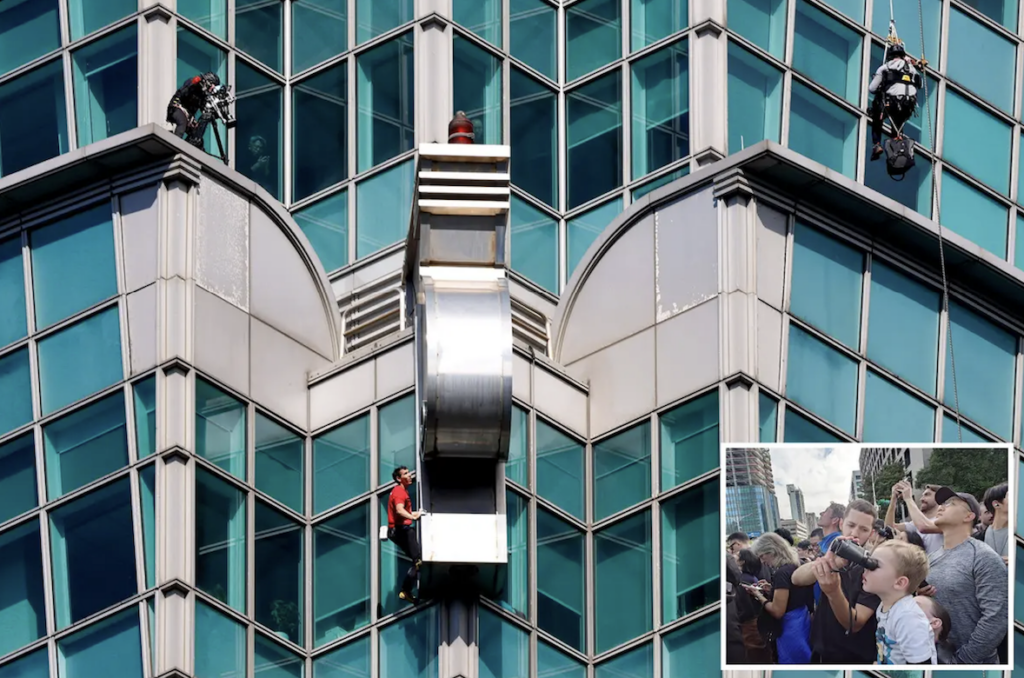
On the day of the challenge, because Netflix implemented a 10-second delay on the livestream to prevent the broadcast of any accidental tragedy, this “death buffer” sparked some controversy online. Some questioned whether such a broadcast was consuming death, but more people focused on the complex gaze of Honnold’s wife, Sanni, watching from inside the 60th floor. The warmth of humanity and the cold indifference of life and death were intertwined. When he finally navigated the lightning rod section above the 89th floor—where his center of gravity hung entirely over open air—and stood atop the spire smiling at the camera, the cheers and the controversy alike were woven into the wind at 500 meters.
Honnold is a story about adventure, but also a measurement of human willpower. Between life and death, there is no transition; during those heart-pounding 91 minutes, every viewer with sweaty palms and weak knees was actually feeling a long-lost, pure tension of life through his fingertips. Honnold used his calm composure at high altitude to tell us: fear itself is not the enemy, the loss of control is. When you cut off all avenues of retreat, all you have left is the absolute focus within that single meter before you, and that is the only path to excellence.

Leave a Reply