
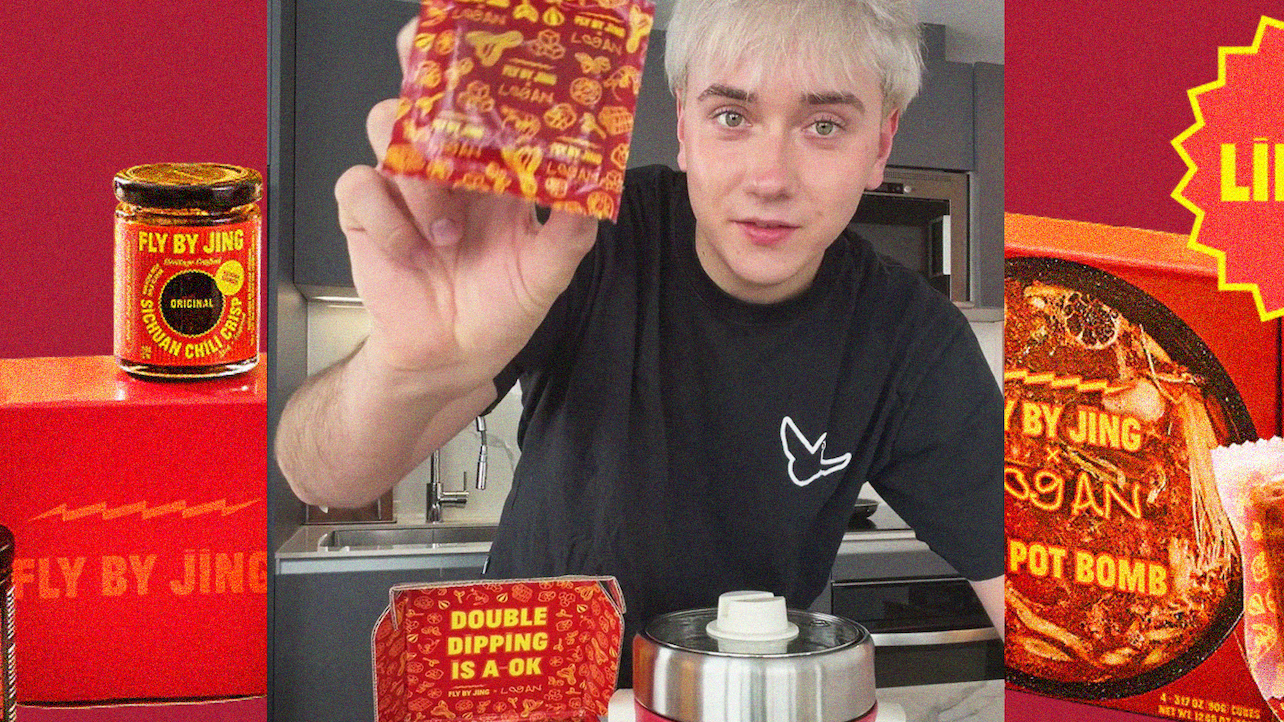
In the parallel universe inhabited by Logan, the TikToker with over 7 million followers, human civilization has seemingly just discovered fire—and he is the Prometheus handing out “Hot Pot Bombs” for $6.25 a pop. Logan, who originally rose to fame by introducing viral cucumber salad to the masses, has recently attempted to debut hot pot seasoning to the Western world, branding it as his own original invention. For those familiar with Asian cuisine, the shockwaves this sent through the internet were akin to someone arriving in Italy and claiming they invented “spiral-shaped wheat dough.” It is a bizarre spectacle: taking an industrial staple deeply rooted in Eastern culinary tradition and, through slick packaging and premium pricing, rebranding it as a “discovery” in a game of cultural colonization.
In his video, Logan holds up a vacuum-sealed block of red, oily seasoning, complete with English labeling. He calls it the world’s first “Hot Pot Bomb,” demonstrating how it conveniently dissolves in boiling water to create a broth. The price is $25 for a pack of four. To an uninitiated Western viewer, this might look like a flashy, exotic new gadget. But to millions of Chinese netizens looking at the near-identical blocks of seasoning that cost less than three dollars for four at any local grocery store, the scene was nothing short of surreal.
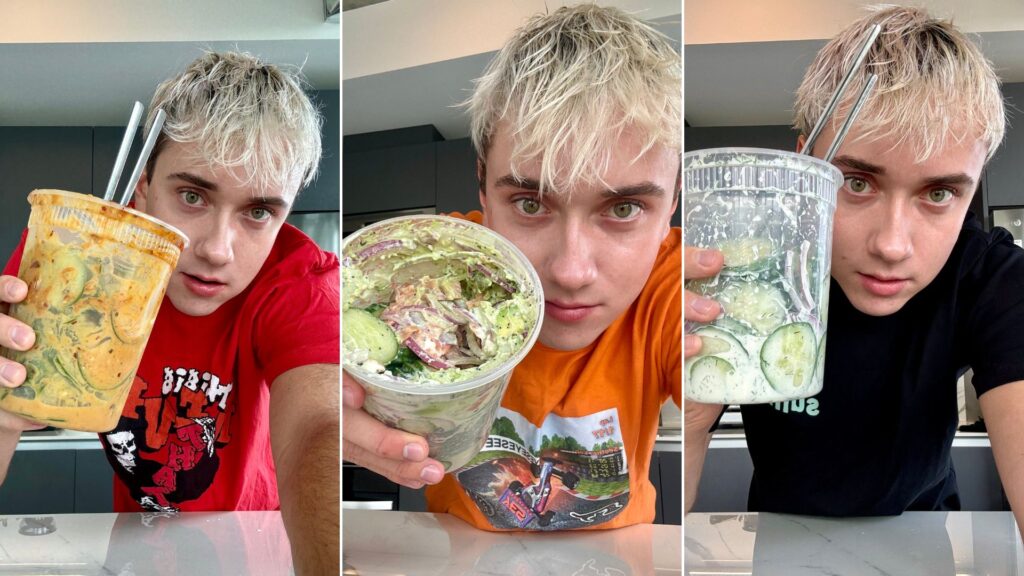
This tactic—using an information gap to pivot from “translator” to “creator”—is a textbook example of “cultural appropriation.” In this context, appropriation occurs when individuals from a dominant culture extract elements from a marginalized or “othered” culture, strip them of their history and context, and repackage them as “innovations” tailored to mainstream aesthetics. This isn’t Logan’s first brush with “decontextualization.” His initial claim to fame involved a “cucumber salad” recipe. By slicing cucumbers and tossing them with soy sauce, sesame oil, wasabi paste, mayonnaise, and MSG in a plastic container, he presented a “healthy, innovative quick snack” to his Western audience. While this dish has a name and a place on virtually every dinner table in China, Logan’s version—scrubbed of its heritage—climbed to the top of Google’s “2024 Year in Search” for trending foods.
There is a distinct flavor of arrogance in this “discoverer narrative.” In the logic of influencers like Logan, if a food or technique hasn’t appeared on a TikTok trending list in English, it is considered “undeveloped” raw material. Renaming hot pot base as a “bomb” is a form of cultural plagiarism. By changing the terminology, he transforms hot pot seasoning from a cuisine brimming with the aroma of everyday life, and often “exoticized” Eastern meal into a modern industrial “plug-in”—not unlike a Nespresso pod, an effervescent vitamin tablet, or a dishwasher pod. While this lowers the barrier to entry for Western consumers, it renders the source culture voiceless. When the same product sells less than one dollar for per in a Chinese supermarket but carries a price tag several times higher in Logan’s shop, that “premium” is essentially a tax on cultural exploitation. He isn’t just selling a product; he is trying to seize the right to define it.
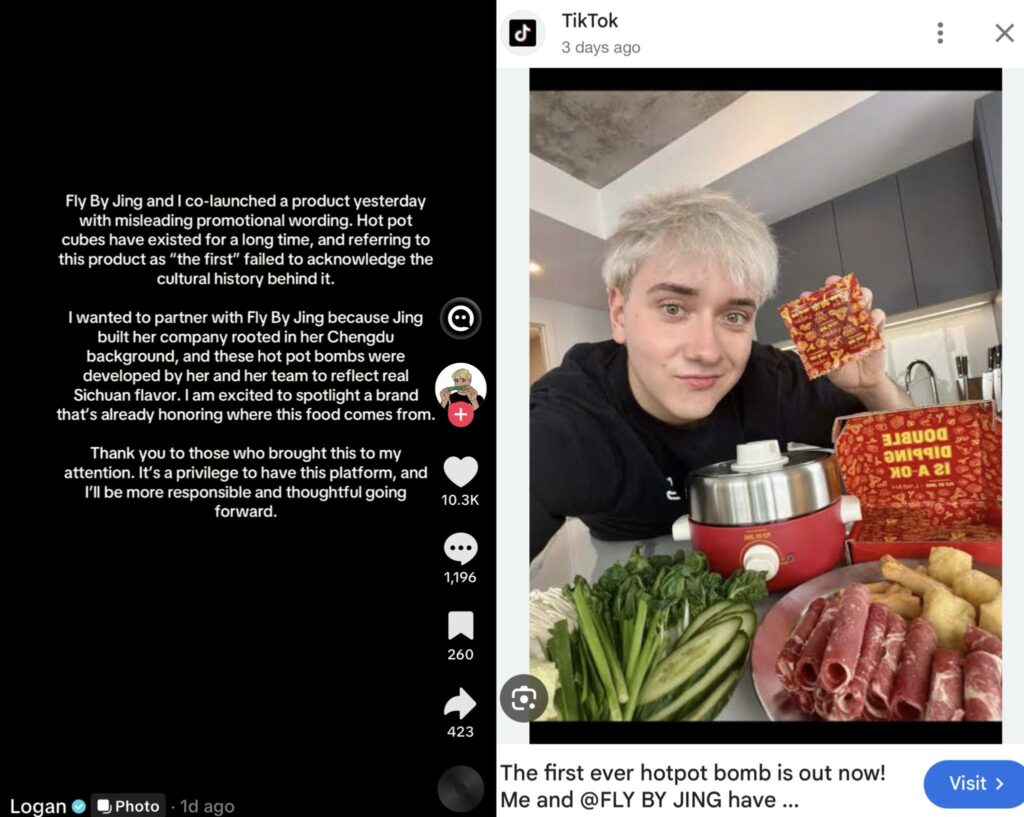
Following global backlash, Logan deleted the video and issued a statement within 24 hours, admitting to “misleading language” and acknowledging that hot pot blocks have existed for a long time. However, the apology felt more like crisis management. This phenomenon is rampant on international social media. Traditions that have simmered for millennia in Eastern civilizations are frequently dressed up in “minimalist” packaging and rebranded as “modern life hacks.” This “reimagining” often carries a patronizing undertone: the implication that a culture must be “translated” or “optimized” by a Western influencer before it is worthy of the civilized gaze.
True cultural respect requires what one might call “footnote awareness.” In today’s hyper-transparent global village, any attempt to build a persona as an “innovator” by exploiting information gaps will eventually dissolve in the boiling water of truth. If Logan had promoted the product by honestly crediting the mature designs found on Chinese grocery shelves and sharing how this seasoning has revolutionized home cooking for millions of people, it could have been a beautiful moment of cross-cultural resonance. Unfortunately, in the “clout-first” era, admitting “I borrowed this from Eastern wisdom” isn’t nearly as lucrative as claiming “I invented this to change the world.”
On the global dinner table, no culture should be treated as cheap, white-label material to be rebranded at will. Nor should a culture be expected to thank the “discoverer” for the privilege of being exploited. Hot pot seasoning is designed to melt, but the roots of a culture and the marks of its history cannot be bought or rebranded for $6.25.

Leave a Reply