
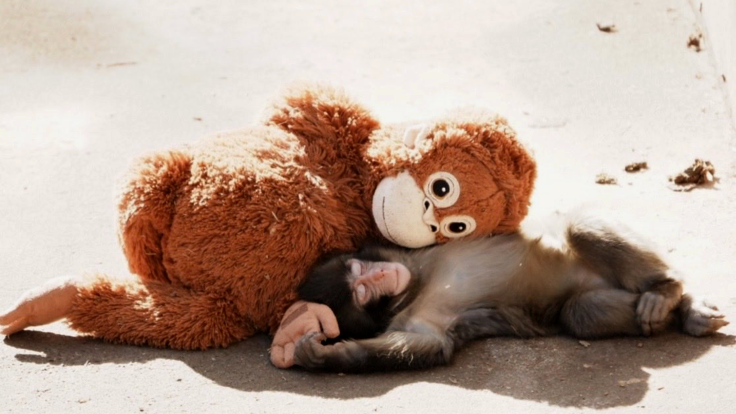
Recently, the internet in Japan has been collectively heartbroken over a “doll-clutching” little monkey. At the Ichikawa City Zoological and Botanical Garden in Chiba Prefecture, a young macaque named Punch is at an age where he should be at his most playful; however, his constant social companion is not a fellow monkey, but a gorilla plushie significantly larger than himself. Whether he is taking his first wobbling steps in his enclosure or facing the shoves and prods of other monkeys, Punch is always seen deathly afraid of letting go, clutching the toy as if it were a lone lifebuoy in a violent storm.
Born in July 2025, Punch’s story began with tragedy when he was abandoned by his biological mother immediately after birth, leaving him to be hand-reared by zookeepers. To alleviate the profound loneliness of an artificial environment, staff placed a soft stuffed animal in his living space. For young primates, tactile sensation is often the first line of defense in establishing a sense of security, and this heartless, pulse-less toy became the sole anchor of Punch’s childhood.
However, as Punch has grown and begun his attempts to reintegrate into the troop, the very gorilla doll that once provided comfort has become an obstacle to his social life. In a video released on February 20, 2026, Punch was treated as an outcast by the other monkeys because of his attachment to the toy, even suffering a violent dragging and shooing from an adult female. Terrified after the bullying, his first instinct was not to flee to high ground, but to scramble frantically back to the fallen doll on the ground. The image of him burying his head into the plush fabric instantly ignited a wave of sympathy from hundreds of millions of netizens. Public opinion surged against the zoo, with many accusing the management of negligence and questioning why such a vulnerable youngster was forced to endure bullying without protection.
In the face of this overwhelming public outcry, the Ichikawa Zoo released a remarkably restrained statement. The zoo explained that the adult female seen dragging Punch was likely “disciplining” him because she felt he was interfering with her own offspring. From the zoo’s perspective, these seemingly crude behaviors are actually a normal part of social friction and discipline within a monkey troop. They argued that Punch’s ability to quickly compose himself after being disciplined and attempt to interact with the others again demonstrates a certain degree of psychological resilience. This explanation touches upon a cruel paradox in wildlife conservation: for an animal that must return to its troop, excessive human intervention can sometimes be its own form of harm. If Punch were to remain forever in the arms of a keeper, he would never learn the complex body language and social etiquette required to survive in macaque society.
Punch’s behavior has reminded many of a famous and somewhat haunting experiment in the history of psychology—Harry Harlow’s “Rhesus Monkey Experiment.” In the mid-20th century, to explore the nature of love, Harlow separated newborn monkeys from their mothers and provided them with two “surrogate mothers”: one a cold wire frame equipped with a nursing bottle, and the other a soft wooden frame wrapped in plush cloth but offering no milk.
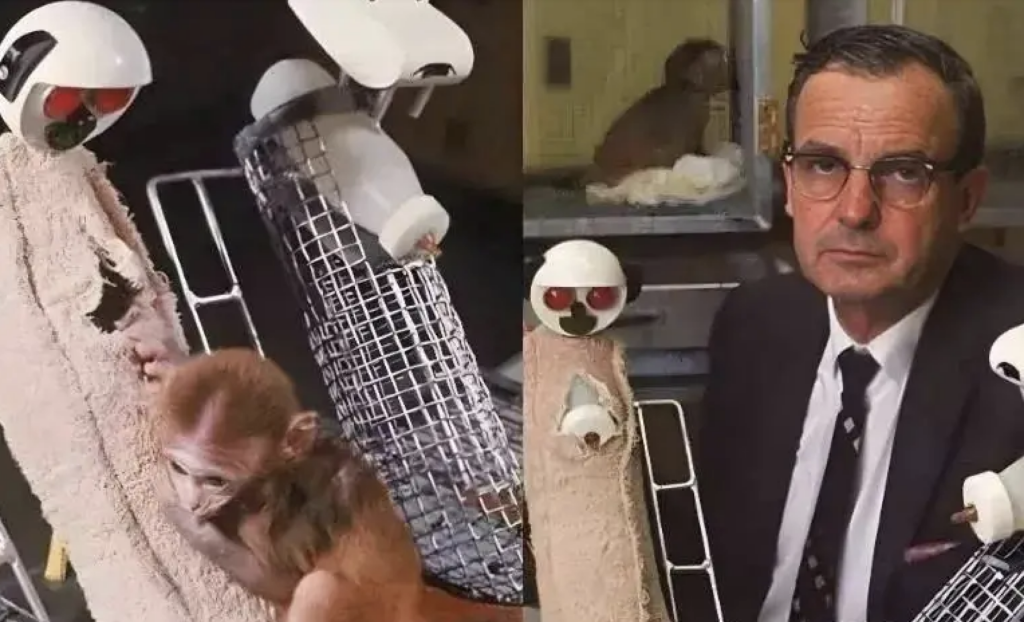
At the time, the academic community largely believed that an infant’s attachment to its mother was purely based on the provision of food. However, the results were shocking: the infants went to the wire mother only when they were desperately hungry; for the vast majority of the day, they clung tightly to the cloth mother. Harlow used this to propose the concept of “Contact Comfort,” proving that for primates, the importance of a warm, soft touch in psychological development far outweighs food. Punch’s “pathological” dependence on his toy is a visceral manifestation of this very instinct—in the absence of true maternal love, he must grip something soft to maintain his fragile psychological balance.
Yet, Harlow’s experiment also carried a sobering conclusion: the monkeys raised only by cloth surrogates, lacking real social interaction and feedback, grew up to have severe personality defects and social impairments. This is likely why the zoo insists on Punch’s integration despite the public pressure. A plush toy can provide momentary solace, but it cannot provide the social skills needed for a lifetime.
Fortunately, the story seems to be taking a brighter turn. According to the latest updates, Punch’s efforts appear to be paying off. Alongside the dedicated care of his keepers, an adult monkey named Onsing has begun to show acceptance toward Punch and has even been observed pulling him into a tight embrace. This hug from a fellow creature—complete with body heat and a heartbeat—is something no high-end plush toy could ever replace. It marks a vital step for Punch as he begins to swim away from his “island of one” toward a real society.
This transition from “object attachment” to “social connection” is a path every life must eventually walk. In the image of Punch clutching his doll, many people see reflections of themselves—the small, fragile things they once clung to when facing the unknown. Today, as he slowly tries to let go of that cloth doll and embrace real warmth, we are witnessing a profound leap of life force. For the netizens following him, the emotion is perhaps less about pity for a monkey and more about the hope of seeing a wounded soul find its way back to its tribe.
Hopefully, in the near future, Punch will still occasionally play with his plush friend, but more often, he will have real companions to groom under the sun, no longer a lonely figure clutching cotton in a corner.

Leave a Reply